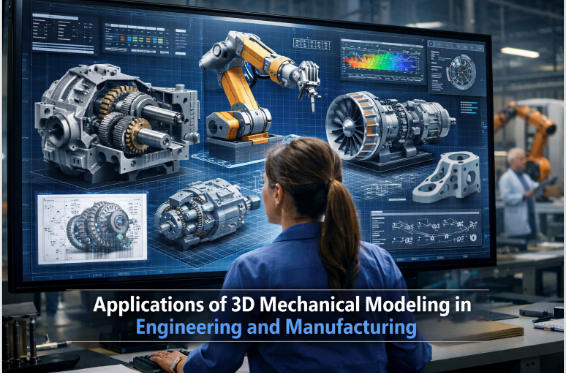
With the complexity of products rising and development cycles shrinking, the conventional design solution alone is no longer adequate. Digital solutions have become the backbone of mechanical system design, testing, and production. Among the various digital solutions, 3D mechanical modeling has become the solution of choice for turning ideas into reality.
Product Design and Concept Development
One of the most popular uses of mechanical modeling is in the initial stages of designing. Engineers use digital models to create graphical representations of parts, assemblies, and mechanisms before any prototypes are created. This helps them test various design concepts without having to spend a single penny.
The designer can analyze the proportions, clearances, and functional relationships between the components at an early stage. Errors in the design can be identified at an early stage, thereby avoiding costly redesigns during the development stage.
Assembly Visualization and Fit Analysis
Contemporary products can have a number of dependent components. It is important to comprehend the relationship between the components. Three-dimensional models assist designers in comprehending the assembly of components to ensure that they are properly aligned.
Fit checks and interference checks assist in identifying possible areas of collision, tolerance problems, or misalignment issues before the product is manufactured. The degree of clarity achieved enhances the accuracy of design and minimizes errors during manufacturing.
Simulation and Functional Testing
Mechanical modeling helps in creating complex simulations that can be used to test the functionality of a product in real-life situations. Engineers can simulate stress, vibrations, heat transfer, and motion on a computer rather than using physical models.
Manufacturing Process Planning
Besides design, mechanical models can also be applied in manufacturing process planning. Engineers can apply models to analyze machining routes, assembly routes, and tools. This ensures that designs are not only functional but also manufacturable.
Digital models help in the collaboration process between the design team and the production team. The models also ensure that the probability of misunderstandings is eliminated. Since the manufacturing constraints are taken into account from the start, it becomes easy for products to move from design to manufacturing.
Quality Control and Documentation
A digital model is a great reference tool throughout the entire production process. It helps with quality control by allowing for exact specifications to compare finished parts to.
Models are also used as the basis for technical documentation such as drawings, assembly manuals, and maintenance manuals. Good documentation is important to ensure consistency, facilitate regulatory compliance, and ensure quality is maintained.
Customization and Design Variations
There are certain industries that require customized or configurable products. Mechanical modeling helps in designing variations without designing the whole system. Engineers can modify parameters, sizes, or elements without affecting functionality.
This flexibility makes mass customization feasible and also helps the manufacturer to respond quickly to the demands of the customers. Digital models also make sure that the variations are as per the standards of design and performance.
Cost Reduction and Efficiency Gains
Cost savings during development and production are always of interest to engineers and manufacturers. Digital modeling also helps in overcoming the challenges of multiple prototypes and waste generation.
Organizations can prevent costly errors in manufacturing by detecting errors early and optimizing designs using digital media. This will directly impact organizations by improving their profitability.
Enabling Cross-Industry Usage
The application of mechanical modeling can be seen in different industries such as the automotive industry, aerospace industry, industrial equipment industry, consumer products industry, and energy industry. All these industries benefit from the ability to model complex systems.
The flexibility of digital modeling makes it an important tool in modern engineering that can be applied to as small as well as large parts.
Integration with Digital Workflows
When the industries implement digital transformation strategies, the mechanical models work seamlessly with other systems such as product lifecycle management, computer-aided manufacturing, and simulation software.
This enables a digital thread from concept to production and beyond. Consistency of data between systems enables collaboration, traceability, and decision-making across the product life cycle.
Leveraging External Expertise
In some cases, organizations may decide to outsource the services of external experts to supplement their human resource base. While the outsourcing of 3D game art services is mainly linked to the entertainment industry, there are other industries to which the expertise can be applied, such as mechanical modeling. Where there is a need for mass production, the completion of tasks within a short deadline, or complex visualization tasks, external help may be required.
Adding Long-Term Value in Product Lifecycle Management
The mechanical models are applicable even after the production process has started. They help in preparing for maintenance, enhancing products, and redesigning. It is easier to search for enhancements or correct problems with specific digital references. Spending on 3D mechanical modeling means that there are long-term benefits because the knowledge about the product is maintained.
Conclusion
There is a need for accuracy, efficiency, and adaptability in the present engineering and manufacturing environment. 3D mechanical modeling helps in meeting this requirement in an effective way. The uses of 3D mechanical modeling are wide and varied, ranging from development and simulation to manufacturing and management. By using the concept of digital modeling, whether done internally or in collaboration with other professionals, such as 3D game art outsourcing services, businesses can remain safeguarded and ahead in the present complex industrial scenario.