Today‘s aviation industry requires pilots to be more than just technically proficient; they must be adaptable, situationally aware, and prepared for the unlikely emergencies. Conventional pilot training, while still a fundamental process, has been vastly upgraded with the addition of new simulation technology.
Of particular importance has been the 3D plane simulator, which provides realistic, immersive, customizable, and repeatable pilot education experiences that greatly augment classroom and limited-seat, mile instruction.
Incorporating accuracy of aircraft operation, real-world environments, and interactive scenarios, 3D simulators improve the way pilots learn and train by providing safe and efficient access to realistic experience.
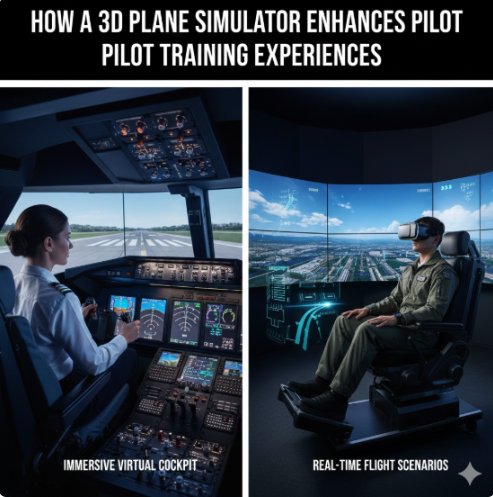
Providing an Immersive Flight Environment
Perhaps the primary feature that makes 3D simulators so beneficial is their fidelity. Today‘s simulators are capable of replicating aircraft cockpits, controls, instrumentation, and external surroundings with both high visual and actual precision.
Pilots flying in such simulators can encounter a wide range of realistic runway layouts, weather conditions, air traffic, and topography, all within three-dimensional space. These immersive visual, auditory, and keyboard/switching elements make the simulation resemble a real aircraft ride as much as possible.
This excellent visual environment allows pilots to gain a better sense of situational awareness, as well as a stronger sense of things like spatial orientation and cues that are quite hard to learn by studying concepts alone.
Safe Practice for Emergency and Other Situations
Some flight situations are prohibitively high risk, unusually rare, or otherwise impossible to practice repeatedly in real aircraft. Critical issues like engine failure, adverse weather, or malfunctioning equipment all pose significant risks if experienced during actual pilot training.
3D plane simulators eliminate this risk. Pilots can repeatedly work emergency procedures without compromising safety. They can get a better understanding of the various troubleshooting steps necessary at different phases of flight, and they can make mistakes without consequences.
Ultimately, pilots who have trained in simulators are more able to respond calmly, appropriately, and effectively when confronted with an actual crisis.
Accelerated Skill Formation Using Repetition
Learning to use an aircraft is a matter of acquiring many different skills, which must also then be combined. Repetition is the only way to perfect these skills and then combine them into an effective whole. Unfortunately, actual seat time is precious, costly, weather-dependent, and limited by aircraft availability.
Simulation makes it possible to repeat specific skills such as takeoff, landing, navigation, or instrument competency, an unlimited number of times without draining resources. Pilots can sharpen weak aspects while not feeling time pressure or financial strain.
This repetition both speeds up the learning process and encourages higher levels of proficiency.
Enhanced Instrument and Systems Training
Modern aircraft instrumentation and onboard systems are central to what flight crews do and how they do it. Seeing how various systems respond during what phase of operations is imperative to safe system use.
A 3D plane simulator can replicate virtually all of these in-flight system displays and instrumentation. It provides non-distracting practice with both navigation and troubleshooting skills. Successful use of such systems in the simulator enables pilots to perform better once they are immersed in an actual aircraft.
Higher levels of system, comprehension, and accuracy are thus achievable.
Better Decision-Making and Situation Management Skills
Flying differs from other mechanical skill acquisition in that it requires rapid or slow decisions based on complex and countervailing data. Accurate judgment of a given situation is extremely important.
Simulators present pilots with numerous different situations involving changing weather, unexpected dangers, or other inadvertent system alerts. Pilots must analyze the various pieces of information, prioritize and respond, and come to a decision.
With this scenario, based training, pilots cultivate their judgment, risk and opportunity analyses, and general awareness, all skills required of the modern pilot.
Offering Consistent and Standardized Training
This training method abounds in sources of variation that can reduce the quality or consistency of individual instruction. Variables include instructor differences, unpredictable weather, and diverse aircraft availability.
With simulators, uniformity is inherent. All users can experience the same challenges under the same conditions. This improves consistency of training experiences and evaluation metrics.
This is quite valuable for the aviation industry, whether it means uniform skills across a fleet of aircraft or the reliability of skill evaluation.
Lower Cost, No Sacrifices
Conventional flying is by its nature very expensive. Fuel, repairs, liability, and wear on aircraft all add up.
Simulators replace much of this flying with inexpensive virtual equivalents, and overall costs are driven down by decreasing use of physical craft as well as increasing training efficiency. Following an initial investment, savings are realized in the form of decreased airline or flight school expenses.
Reduced costs ideally lead to more pilot training, further saving money without sacrificing quality.
Bridging the Divide Between Learning Theory and Actual Cab
While many key concepts (aerodynamics, weather, navigation, etc.) are analyzed theoretically prior to real-world application, the latter remains powerful and more impactful. The disparity between a theoretical framework and experiencing the thing firsthand can make learning slow.
Simulators address this problem by bringing theory directly into an immersive environment. Pilots have the opportunity immediately to translate their conceptual comprehension into actual contextual experience.
This reinforcement of knowledge allows for superior learning outcomes.
Objective Performance Feedback
3D simulators gather comprehensive data concerning pilot inputs. An instructor can glean exact information on the path taken, control usage, response lag time, and decision quality.
Such an information feedback loop permits objective assessment of skills instead of subjectively delivered coaching. It gives pilots a clear visualization of what needs practice.
Consequently, performance improvements are swift, and learning is more systematic.
Training for Advanced Skill Sets
In addition to standard flying skills, simulators can cover advanced learning topics such as:
- Multi-crew coordination
- Recurrent instruction
- Multimodal or specialized flight procedures
Having such a broad offering of simulation training is invaluable for organizations needing to cross-train as well as update pilots on new aircraft.
The Importance of a High-Quality 3D Asset
The advantages of simulators depend greatly on the quality of the system components and modeling involved. A 3D simulator only performs well when they are based on accurate geographical layouts and aircraft physics.
This is a primary reason for the importance of expert 3D modeling services. Meticulous geometric, textural, and system, the animate building ensures visual and operational fidelity, contributing to the fidelity of the resultant training experiences.
Enhanced quality assets also futureproof simulators, as they facilitate easy updates, upgrades, and new asset development.
Preparing Pilots for Tomorrow
As aircraft continue evolving, flight crews will need to adapt still further. Simulator-based training gives pilots the adaptability, analytical skills, and confidence necessary to excel in tomorrow’s aircraft.
Conclusion
In closing, the invention and integration of a 3D plane simulator has provided a powerful training modality that complements and exceeds conventional flight instruction. It offers consistently accurate practice that is safe, efficient, repeatable, immersive, and scalable.
Supported by expert 3D modeling, simulators can deliver high-precision learning experiences that develop the skilled, confident pilots needed to navigate our modern and future skies securely and effectively.